Showing posts with label welfare reform. Show all posts

Saturday, 25 January 2014

What does it mean when one million people are found fit to work?

DWP says almost one million sick found fit to work reports The Huffington Post:
A third (32%) of all new claimants for employment and support allowance (ESA) were assessed as being fit to work and capable of employment between October 2008 and March 2013 - totalling 980,400 people, the Department for Work and Pensions (DWP) said.
We've now had five years of reporting the numbers of people turned down for ESA as some kind of success story; they're getting disabled people back into work. A third of those who claimed ESA are being found fit to work. Welfare Reform is justified!

Those turned down for Employment and Support Allowance are not necessarily making false claims. They may be fit to work but have not understood the rules, or they may be unable to work but have struggled to fill in the form in such a way that conveys this. Some of those turned down may have had a good case for appeal (40% of appeals are successful), but couldn't face the ordeal. The fact that this complex and mixed group number a million people (or strictly speaking, a million claims) seems unremarkable.

The criteria for Employment and Support Allowance are much stricter than those of Incapacity Benefit, the process takes many more months, with many people either dying, getting better or giving up before a decision is made and some claimants' benefit is stopped after the first year if they have savings or a working partner. Despite this, there were still 2.49 million people on ESA and other incapacity-type benefits in 2013, against the 2.6 million on incapacity benefits in 2008.

Reform to this benefit, at massive cost to government, a very great deal of  personal stress, heartache and hardship for disabled people and their families, as well as a media-driven regression in social attitudes towards disabled people, has only succeeded in reducing the numbers on this kind of benefit by 110,000 people or a little over 4%.

This is what has been achieved since October 2008; there are a little over four percent fewer people on ESA and related benefits than before. It is unclear whether or not the incapacity bill - either in terms of benefits or the cost of assessing for and administering benefits -  has been reduced. A stable 40% of appeals against ESA decisions are successful. Fraud levels (around 0.3%  for incapacity benefits) remain stable.

Meanwhile, the vast majority of those found "fit to work" will have simply moved onto other kinds of benefits such as Job Seeker's Allowance. Disabled people who are fit to work remain unlikely to actually get work, largely due to discrimination.

Tuesday, 2 April 2013

Overheard in the Waiting Room


This morning, I took a pair of gruesomely infected toes to the doctor's. During the long wait, I politely eavesdropped on a conversation between three friends who had bumped into each other (that is, they had met by accident; they weren't seeking medical help having violently collided). I would guess that they were around retirement age, or maybe a little younger, two women and a man; ordinary folks. They competed as to whose winter coat had lasted longest, discussed Strictly Come Dancing and expressed some nostalgia for The News of the World before it went trashy.

Then they had a conversation, which went something like this:

A: Of course, all these cuts have just come in, haven't they? A lot of people are going to be struggling.
B: Oh yes. It's not fair that the poorest people should have to pay when it's the bankers who got us into this mess.
C: I know. It's only going to cause the country trouble in the long run, making people so badly off.
A: But there are some people swinging the lead.
B: That's for sure. You hear a lot about disability fraud.
C: Yeah and everybody knows somebody, don't they? Someone who's working the system.
A: But there's a lot of propaganda about that, I think.
B: Of course, the government want you to think they're all the same.
C: You can't believe anything you hear, that's for sure - especially not from this lot!

It went round like this, several times, sometimes with specific anecdotes or particular stories they had seen on the television and in newspapers. At one point, there was a very nuanced discussion of workfare (although they didn't use that term), which talked about the difficulties someone might have if they had depression, would benefit from work and might sign up for one of these schemes, only to get in trouble when they struggled to get out of bed in the morning and were late for their placement. Because people with depression can have trouble getting out of bed in the morning, however hard working and enthusiastic they are.

But time and again the same sentiments were repeated:

  1. Some people are on the scrounge for sure. 
  2. Some people are really suffering.
  3. You can't believe anything your hear.

This disbelief was extended across the board. At one point the conversation shifted from a discussion of just how difficult it was going to be for some people - just how little money people would be left to live on - to the "scare-mongering" about how difficult it was all going to be.

And this is the trouble we have; the position that ordinarily apolitical people who are not directly affected by the cuts have been placed in. They don't trust what they hear - least of all from politicians. They care about the fact that people are being left with little to live on, and the removal of crisis safety-nets like the Social Fund and Legal Aid for civil cases. But, weighing the balance of everything they've been told, they feel that there's a fair amount of cheating going on and that needs to be stopped.

Most people I speak to, outside of disabled, poor or otherwise politically active types, feel the same. They support Welfare Reform in principle (and why not? Few people feel there's no room for improvement), they are anxious about how this effects vulnerable people in practice (People like you). But they don't know what the answers are and they feel that everyone who has a voice in the public sphere is probably lying to them.

I don't know what the answers are, but I wonder if this conversation is about to change. Although there's more to come, a lot of the cuts which came into place on Monday have been a long time coming, and the real life consequences have been - while reasonably speculated about - as yet uncertain. Now it's happening. The poorest people are poorer than they've been for many years. There are many more of them.

And maybe there's some optimism to be taken from the fact that people are confused. A few years ago, when the scrounger rhetoric had just got underway, I think the friends' conversation would be less balanced. The deserving poor would have been spoken about as rare exceptions, as opposed to "many".

See Also: John Harris: We have to talk about why some people agree with benefit cuts.

Friday, 13 July 2012

Guest Post: Supported Mortgage Interest and Welfare Reform

This is a guest post from @_louhicky.

A limited range of accessible housing restricts the lifestyle choices made by disabled people. There has been a lot of discussion about accessible housing in the media recently. Last week The Guardian published the article ‘Young disabled people failed by estate agents and property websites.’ The study ‘Locked Out’, recently compiled by The Trailblazers, a group of young disabled people, highlighted the common failure to understand the needs of wheelchair users; particularly with respect to what makes an accessible property. (NB: I know there is a glaring disability hierarchy at play here, for the sake of this blog I am going to put this argument aside. I’m taking note of it.)

The lack of social mobility is worth a mention here and the long-term implications of suffering restrictions within the housing market. In clarifying what I mean by social mobility: to many this signals the ability to move vertically or even horizontally within social classes. To progress, to study, to live independently, to obtain employment, to buy a car, maybe even an annual holiday, or simply to aspire to something. I’m not so interested in movement between social classes, but rather the importance of having choices - even if they are related to materialistic desires. One comment by user cycleloopy on The Guardian’s feature, states:

Estate agents want to do the least amount of work for the most return. Recognising the needs of people with disabilities sounds too much like hard work.

There is a stinging element of truth here, but let’s reframe this comment. Estate agents desire profit, this limits the housing stock or profile for those who seek accessible housing. The private rental market is not a realistic choice for people who require adaptations to be made. Again, the ‘Locked out’ report found that seven out of ten say they find it difficult to identify accommodation that is accessible to them, largely because estates agents have poor knowledge of adapted properties in their area.

The chances of successfully appealing a decision are quickly evaporating under the coalition government, leaving disabled people left without choices, trapped within their own circumstances. What’s next, the property ladder? Yet, the [Locked Out] report found that nine out of ten people say that they are just as keen to get onto the property ladder as their non-disabled peers.

Home Ownership schemes (which have been mainly brought about by the Labour government) such as HOLD (Home Ownership for Long term disabilities) increase the availability of accessible housing, especially if these free up local authority properties. Effectively, this creates a small-scale economy for people with disabilities, and, as a result, creates demand and opportunity for others. Ownership is currently, albeit rather precariously, available with the assistance of Supported Mortgage Interest (SMI), which has been extended under this year’s budget until January 2013. However, SMI is presently under review (the consultation period ended in February 2012), and it would seem that the coalition government is underestimating the power of ‘crip economy’ and its potential as a source of fiscal stimulus. The DWP’s SMI impact report shows that there were roughly 239,000 recipients benefiting from this scheme in 2011/12, at a cost of £400m.

Under welfare reform it has been suggested that SMI will be further incorporated into the Universal Credit system, however this complex process of streamlining benefits would undoubtedly mean that some people are likely to be left out. A Guardian feature from late last year, Disabled people pay price for cuts to mortgage relief revealed that regardless of these changes, SMI payments have become unpredictable, as they already have been subjected to cuts. When, for instance, average interest rates fell below 6.08% some people enjoyed a surplus on their payments, whilst when the rate was cut to 3.63%, others found their payments falling short of what was in fact owed. Under pressure, then, from both Welfare reforms and unpredictable SMI rates, disabled people are prevented from making the move onto the property market that they ostensibly desire, and as a result fully adapted homes are lying empty.

It is evident therefore that the long waiting list for accessible properties substantiates the idea that there is high demand and no supply. Indeed this is not helpful whilst transferring between local authorities with care packages. The ‘Locked Out’ report reveals that eight out of ten people are not confident that they would be able to access the same level of care and support if they moved out of their local authority. Similarly, relocation for a new job is almost impossible. As Channel 4’s No Go Britain highlighted in its interview with Hannah-Lou Blackall. No housing means no job.

A lack of housing options denies disabled people the basic right to make choices about their lifestyle. The ‘crip economy’ shows potential for growth, but the enforcers of housing policy need to ensure that local authorities are building all new housing options to the Lifetime Homes Standard, and even further that ten percent will be built to wheelchair standard design.
This post hasn’t even begun to tackle the adaptation of existing homes, or cooperation of private landlords within the letting market. In the United States, an accessible apartment is defined ADA (American Disabilities Act) accessible, clearly labeled, and clearly following the lines of the disability law - most importantly defining a standard within the marketplace. In order to be classified as ADA accessible, properties have to meet certain legal requirements: there is no room for subjective interpretation, or making do with already-existing properties and their flaws. If the British government adopted tougher measures, recognizing the value of choice, whilst sustaining the current growth of both social and private markets they could offer people the chance of taking their dream job, or ensuring that family growth and long term security is achievable, or even, quite simply, the chance to live with flat mates without complex bureaucracy.

More information: My safe Home - http://www.mysafehome.info/

Sunday, 6 May 2012

A hidden benefit cut #counciltaxbenefit #welfarereform #wrb

On Wednesday I attended a forum of people who are for the most part volunteers and campaigners. The main purpose of the event was to discuss the planned changes to housing benefit or local housing allowance.

Another benefit change was also briefly discussed. One I hadn't been aware was happening.

As of April 2013 Council Tax Benefit will no longer exist in its present from. It was suggested by the facilitator at the forum that the news of this change has been lost in all the information and outcry about the planned housing benefit changes. I leave you to make your own mind up about whether this was done deliberately by the government. I did wonder just how it was I hadn't heard of this.

Council Tax Benefit is centrally controlled at the moment. You apply to your local council but the rules and money come from a central pot. It's not strictly speaking a disability benefit. A lot of disabled people do receive it but it's available to anyone who is on a low enough income. A high proportion if the people who receive it are in work and for some it is what allows them to remain in work or to take work in the first place. Currently it's possible to receive all or part of your council tax paid via benefit (claimants don't receive this money it goes straight to the council) and also in some circumstances to receive a separate discount for which you don't need to be on benefit.

So in my own case
My council tax bill is discounted by 25% because I live alone (this is called the single adult reduction and any household where only one person over 18 lives is entitled to it. Claimed via contacting the council)

My flat is a band b property however because I'm a wheelchair user the council tax due is reduced by 1 band meaning I'm liable for band a prices. For people who live in band a it's reduced by a set percentage. (this is available to anyone who needs extra space for wheelchair use or an additional room due to medical needs. Again claimed from the council)

And as I am deemed to have a low income I receive Council Tax Benefit which in my case pays the remainder in full.

If I was working I may have received some benefit and had to pay the rest. It really is on a case by case basis. I know of people who receive perhaps only £15 a month council tax benefit and pay the rest and people who receive all but £5 a month of their council tax in benefit and pay that £5

From April 2013 however there will be no set rules for the provision of council tax support. Instead it will be provided locally with each area deciding how best to use it. The pot of money to be available for this is to be 10% less than the current bill for council tax benefit and this money will not be ring fenced.

This will almost definitely create a postcode lottery in what support is available. My suspicion is that areas which are already poor at providing services such as social care are likely to also use little of the available money for council tax support. Yet another hit for disabled people and for many others who may well not carry the scrounger stereotype we crips must fight.

The government would probably argue that if people have enough income to be only receiving a small sum of council tax benefit each month - say the £15 I used above - they can afford to pay that too.

It's easy to say that when you have a high paying job, secure accommodation, good health and family who support you like most of the government do. £15 is maybe a starter in a restaurant. They miss it but it wouldn't be a big deal and come next week they probably wouldn't remember it.

It's not so easy when you're on a low income. The £15 you've just lost could mean you can't pay for your prescriptions or you can't eat for a few days or the carer who comes once a week to change your bed must be stopped. Not easy to manage without and not something you can say "oh well" and forget about.

Edited (by Lisa) to add: We've had quite a lot of Tweets related to this post. As not everyone follows us on Twitter so will have seen them RTed; I thought I should post some of the more crucial ones here to add them to the debate. The limits on what html can be used in comments means you can't embed tweets below the line.


Tuesday, 17 April 2012

Guest post: Personal Independence Payment – The Next Great Welfare Train Crash

This is a guest post from @johnnyvoid and originally appeared here.

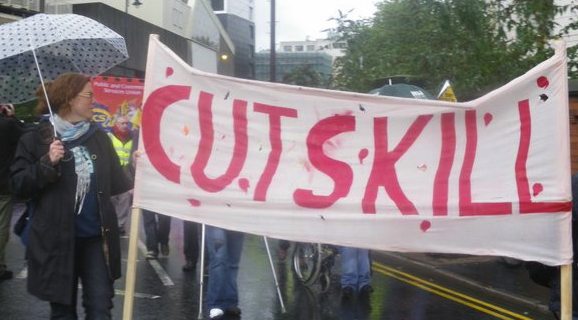
Banner with 'cuts kill' painted on in red
Brutality combined with incompetence are becoming the hallmark of the current Tory administration and the plans to abolish Disability Living Allowance (DLA) are riddled with both. The Government is driving ahead with their plans to replace DLA with the new Personal Independent Payment (PIP). The aim of this is to strip benefits from a fifth of disabled people.

This will be achieved by using an independent medical assessment as the key part of the decision making process when considering a claim for the new benefit. That assessment will be carried out by a private company.

We already have an effective model of how the new scheme might operate. The Work Capability Assessment (WCA) is a short computer test carried out by French IT firm Atos which is used to determine eligibility for the out of work sickness and disability benefit Employment Support Allowance. For everyone other the Government and Atos themselves, it has been an unmitigated disaster. The constant assessment and re-assessment regime has driven an increasing number of people to take their own lives. A recent Daily Mirror investigation found that 32 people a week die after being declared ‘fit for work’ by Atos. Around 40% of appeals against Atos’ decisions are successful and the appeals system is in meltdown due to the number of cases being brought.

Despite some tampering around the edges due to a recent review of the process, there are no plans to abolish or significantly reform the WCA. This should serve as a stark warning to people facing the new PIP testing regime. The Government are happy with Atos the way things are. Lots of people are losing their benefits. That was always all they wanted.

The stated agenda of PIP is to remove benefits from 20% of disabled people. All other mealy mouthed attempts at reform are secondary to this. It will be down to the private sector to carry out this cull. In many ways the PIP process will be identical to the WCA. It may yet even be Atos who carry out the assessments.

This will not only prove traumatic for the people forced to undergo demeaning health tests, but will bring devastating social costs. The Government’s plan that “entitlement will depend on the person’s circumstances and the impact of their health condition or disability on their everyday lives” is vague and open to all kinds of interpretation.

How it will be measured in practice is anyone’s guess. Given it’s the private sector who will be carrying out the bulk of the work the answer is likely to be the cheapest way possible. It will be difficult to imagine how, for example, being in full time work can be ignored by any assessment. Under the WCA claimants who have admitted to watching Eastenders have had it used against them as evidence of being ‘fit to work’. It is therefore very likely that having a job will come to be seen as a disqualifying criteria for claiming PIP, if not formally but as a reality of people’s experiences. This may not be the Government’s intention, but in practice it seems unavoidable.

Atos, as well as human rights abusers G4s and private sector sharks Serco, are some of the companies believed to be bidding for the PIP contract. They should be warned it is a thoroughly poisoned chalice. Atos have already seen their reputation destroyed by the WCA, with the name of their company becoming a dirty word. This will seem trivial should they take on the PIP Assessments.

DLA is a non means tested benefit designed to help people meet the additional costs of disability or ill health. In many ways it should be seen as an adjunct to the NHS rather than a benefit comparable to those paid to people unable to work. DLA is used for things like additional transportation costs, specialist equipment or personal care. For many working disabled people these things are essential to help them remain in work. As Disability Rights UK have recently pointed out (PDF), the removal of DLA from over half a million people may drive many into unemployment.

People currently claiming DLA include doctors, lawyers, journalists and MPs. Whilst those claiming out of work benefits are by their very nature economically disempowered (in that they don’t have jobs and are forced into the poverty of the benefits system) many DLA claimants are highly skilled professionals. We could face the unedifying spectacle of Doctors having their health and disability needs assessed by the two bit NHS rejects at Atos. Disabled legal professionals may yet be forced into the appeals system and are likely to prove ferocious. Any company which takes on the PIP contract will face unprecedented resistance at grass roots level, from people in some cases far more qualified than their own assessors. It will be doctors, lawyers and journalists lining up alongside benefit claimants to take action against the companies concerned.

Imagine becoming public enemy number for not just the three million plus DLA claimants, but their friends, families and carers. People with many more skills and resources to fight than those on out of work benefits. Every mistake, appeal or careless remark by an assessor will be scrutinised. Assessment centres and other business sites could find themselves thronged with disabled protesters. An avalanche of legal challenges seems almost inevitable.

It is possible that on the ground a two tier process will develop. Disabled doctors and lawyers may be informally waved through the process in the hope they won’t make too much fuss. Can we honestly believe that David Blunkett or a Paralympian Gold Medal winner will face the same kind of scrutiny as an out of work disabled single mum living on a Council Estate?

The alternative is that the PIP assessment will become an unofficial ‘means test’. Those in work, or able to lead more active lives, may find themselves punished as any sign of independence is used against them. However the upcoming farce plays out it will prove catastrophic not just for disabled people themselves but for the wider credibility of the system.

As we have seen under the WCA regime, there will be more suicides, more appeals and more people having conditions made worse by the stress of endless testing. The Government says that only in very few cases will PIP be awarded for life. This will mean for example, that people who may have lost a limb will be forced back to continual re-assessments, presumably to check it hasn’t sneakily grown back.

Despite lurid headlines DLA is not an easy benefit to qualify for. A wealth of medical information is required, from GPs, consultants and other health professionals. As with the WCA, this is likely to become secondary to the short assessments carried out by private companies. As more disabled people are forced into poverty it will be down to Local Authorities and the NHS to pick up the slack. Just like so much of this Government’s Welfare Reform, it may yet cost more money to go down this road than simply leaving things as they are.

The Government are currently consulting on the changes and you can make your feelings heard here. If past consultations are anything to go by then don’t expect them to listen. The over privileged tory toffs have made their intentions well and truly clear. Don’t think that this scum will shed any tears for those driven into poverty or even suicide by these changes. As Maria Miller, the Minister for Disabled People has already said, the cost of disabled people is simply ‘unsustainable’. That tells us everything we need to know about this Government’s attitudes towards sickness and disability.

Join the growing protests against Welfare Reform including action called in Central London by Disabled People Against Cuts on the 18th April (tomorrow!).

Tuesday, 10 April 2012

Guest post: When "the vulnerable" have everything to fear

This is a guest post from @Spoonydoc and originally appeared here.

Many disabled people are currently living in fear since the welfare reform bill became law. Some benefits are due to be replaced with stringent new criteria which mean that many disabled people will no longer qualify for support. With social services cutbacks many will be left with no help whatsoever.

I am not quite in that position. I am among what the government likes to call "the most vulnerable". Currently in receipt of the highest levels of disability benefits and having easily passed the new dreaded draconian Work Capability Assessment I am in the support group of what is called ESA and am not expected to be able to work again. Having seen the criteria for the new benefits it is clear that even being as harsh as possible, I should easily qualify for the highest rates of these too.

With the government having promised that the reforms will see more support diverted to the "most vulnerable in our society", you would therefore think I have nothing to fear.

You couldn't be more wrong.

I currently live independently.
As I live alone I receive an extra payment called SDP (severe disability payment) which helps cover the extra costs of care and disability.
However a large portion of this and my other benefits goes to social services and in return I receive direct payments, money with which I employ carers to help me with every day tasks such as getting dressed, washed, eating, shopping, etc.
My LHA (Local Housing Allowance) is upgraded to a 2 bedroom rate so that carers or family can stay when my illness is so bad that someone needs to stay overnight.
My flat was adapted 8 years ago so that it is wheelchair friendly.

When the changes start coming in next year, all this will go.

a) SDP is being abolished completely.
b) The 2 bedroom allowance is no longer guaranteed.
c) I will continue to have to pay most of my benefits towards my care. I cannot manage without it.

I calculate that I will be around £80 per week worse off (around half from SDP and half from LHA).
At first I might be ok. Apparently there will be a transitional protection as far as SDP goes, which means I will only be £40 worse off and might be able to get that together somehow. As time goes on however, that will be eroded by inflation and benefit freezes.

The second big issue is : I cannot manage without a second bedroom.
Even if I could, there are no wheelchair friendly 1 bedroom flats available for rent privately (I've been looking). As far as social housing goes there is little wheelchair accessible housing available and in any case I am not allowed a bungalow until I am 50, ie in 17 years time!

So I either have to go into non wheelchair accessible accommodation without provision for my carer or go bankrupt!

The only other solution is for me to go into a care home at the ripe old age of 35. Ironically this will cost far more than if I were to stay put and continued to be paid benefits.

Before the election David Cameron said "If you are sick, disabled, frail, vulnerable, or the poorest in society you have nothing to fear."

Sir, please look me in the eye and say that now.

Tuesday, 10 January 2012

A Topsy-Turvy World

Just a few days after it was revealed that Boris Johnson disagrees with the DLA reforms, Ed Miliband has today reinforced the fact that he is to the right of some of the people that sit in the benches opposite him.

In his speech today at the Oxo Tower - the speech which was supposed to be offering a "new direction" for Labour - he, once again, starting banging on about us "irresponsible" types at "the bottom of society".

Government also has a particular responsibility when times are tough to ensure that rewards go to those who work hard and do the right thing.

That is why we have to take on irresponsibility wherever we find it.

At the top and at the bottom of society.

[...]

We are determined to reform our welfare system too, so that it rewards those who do the right thing.

That’s why I’ve said that those on the waiting list for council accommodation should move up that list if they are contributing to their communities, being good neighbours, and seeking work.

Now, I'm sure his defenders will claim "but he wasn't talking about disabled welfare claimants, just the other ones." Really? The non-disabled ones who already face JobSeekers Allowance sanctions if they turn down, or don't look for, work?

"Those who do the right thing." There's a "right" way to be ill in order to claim ESA? How does that work? Am I supposed to look and act like I've just rolled out of a Children in Need appeal in order to claim DLA/PIP? We all know I'm far too loud and sarcastic to pull that one off. Or is that how they plan to assess for the benefit: Screw taking our limitations into account, just judge us out of 10 on a cute-o-meter?

And as for seeking work to get a council property: What about those of us that can't work and are more likely to need council housing for related reasons? "Well, you're cute enough for ESA but you'll just have to be cute on the streets. It's OK, you're adorable enough for people to throw their loose change in your cup of tea."

We've known for a while the Ed is just a Tory in a red tie (so hardly a "new direction". It would've been more New Directiony if he'd burst into songs from Glee). But for him to reiterate that in the same week that BoJo became a welfare hero just makes your head spin.

Thursday, 6 October 2011

Scottish Welfare Reform Bill Debate

This is a guest post by Michael S. Collins, about the Scottish Welfare Reform Bill debate. He wrote this yesterday evening, after the debate had taken place.

So today, the Scottish parliament stood on what had been called potentially their finest hour. If in doubt, start posts with hyperbole. Nevertheless, it was an important moment, as Holyrood got ready to debate the infamous Welfare Reform Bill, proposals which have divided people, even from the same party.

Before the debate, there was a statement on the fuel poverty allowance, followed by queries from several MSPs including Patrick Harvie. The most interesting news to stem from that was the idea that the heating bill scheme was to be extended to that long misused service to society, carers. The feeling seemed to be, on the whole, we aim to keep our promises in this area, even if 'them down South' try to slash our budget.

Deputy SNP leader, and regular sight in Govan, Nicola Sturgeon opened the Welfare debate with as clear a statement on government policy as we shall hear for some time. "We want a welfare system which is fair to all." She followed up with an attack on a system which allowed genuine claimants to be found "capable of work". It was her conclusion that "We must recognise some people are unable to work and must be able to life comfortably on benefits." The Big Society was on the other channel, but Call Me Dave politics this was not.

Jackie Baillie opened the debate for the Labour party, who were mostly to agree with the SNP policies with a few tweaks. "Attacks on the welfare state is nothing less than an excuse to cut." She said, before turning to former Scottish Tory leader David McLetchie. In a pre-emptive strike, she warned him not to bring up the "13 years of Labour misrule" agenda once more, before throwing a dig in at the nearly entire missing Liberal Democrats: "Beveridge would be ashamed to see the Liberals cosy up to this".

Alongside Patrick Harvie's earlier assertions that he planned to argue against the WRB, so far the score suggested it was SNP / Labour / Green for, Tory against, and Lib Dems unaccounted for.

We now handed the debate over to Mary Scanlon of the Scottish Tories, one of that famous breed of formidable Sexagenarian / Septuagenarian Conservative women which populate parts of Scottish politics. At this point we got a lot of Labour mentions. Labour's legacy. Thirteen years. Unelected Prime Minister (though, the evidence that polling for Labour in 2005 rose after the "Vote Blair Get Brown" campaign suggests the general public didn't really disagree with that idea at the time). You know the jist. A lack of "the mess we inherited" in all but name. "39% claimants gave up claims as they didn't need it anymore." Other such familiar claims were made.

Liam McArthur of the Lib Dems, and the only Liberal Democrat available, had the floor now. "I do not accept the Welfare Reform Bill means the dismantling of the welfare state and benefits system" he started. Then he went into the usual Liberal defence of the Conservative policies. Nothing new to report there.

Bob Doris took the floor.

"We must speak out against the Bill, which is unfit for purpose, even if we can't prevent it."

"A savage attack on the most vulnerable groups in our society. [WRB] is cutting cash at any price. It is not a price worth paying."

A female MSP rose to speak next. The tag team of the washing machine and the sound problems on Holyrood.tv meant I never caught who it was, so anyone who knows, please let me know.

"Welfare state is a sign of compassion" she said, expressing that "Social ails" stemmed from the events of the 1980s. "We need safeguards for those who play by the rules and need nothing more than help from the state at their time of need."

Mark McDonald, SNP, was next to refute the claims that the SNP were sensibility and nae sense, as he noted that he had met "many voluntary groups and charities" who "have made sensible ideas for reform that wouldn't hurt the vulnerable."

"60% of genuine claimants rejected, being overturned on appeal suggests something wrong with the system."

"If it is your mistake, you'll be punished. If it is the UK governments mistake, you'll be punished."

He followed this remark up with a reference that 'Sir Humphrey Appleby' would be proud of this system, endearing himself to Nigel Hawthorne's legion of fans and politicos alike. His parting dig - "Now is the time and the hour for the Liberals to show their 'civilising' impact on the Tories" - was given with expert timing. McDonald is a new SNP MSP, elected in May during the landslide, who famously showed up at his count in jeans and T-shirt, so utterly unconvinced he was of his own victory. Here he made an impassioned speech.

Margaret Burgess, SNP, was swiftly to steal the show, however.

Key points?
  • The [WRB] "will have long term detrimental effect to Scotland."
  • "I worked as an advisor. People want to work, not wanting to work is untrue, they are not getting the help they deserve."
  • "20% less will get help even if they need it. That is wrong."
  • The circle of ESA/JSA/ESA/bad decisions "badly effects mental health of the most vulnerable."

She spoke with the full authority of years of experience, and with the full passion of someone who had first hand seen the hopelessness and victimization of the vulnerable in the name of society.

For fear this is turning into the SNP propaganda society, up next was Siobhan McMahon, a young Labour MSP of whom I was unaware of. It is hard to argue that her opening gambit was not one of the most strongest in the debate. "I have (a form of) cerebal palsy. It is surprising how easy it is to forget how you can't do normal things." She added: "I am better off than many others though, and it is for them I am passionately opposed to the [WRB]." McMahon showed an effective and well honed use of the orators mantel, noting of those who screamed about 'unnecessary benefits' that "Benefits cheats in this suspicious society invade their dreams like so many sprites and goblins." A brilliant use of rhetoric. The SNP may have held the floor and had the most condemnations of the ConDemNation (sorry, couldn't resist), but this was the most flowery and brilliant Footian quote of the day. Siobhan McMahon went on to warn that Scotland will "suffer disproportional by this reform, due to our high level of disabled people", and that, as an example against those who say looking harder for work is the solution to all our welfare woes, "Only 12% of people with aspergers in this country are in employment."

Annabelle Ewing, SNP and Winnie's daughter, was up next. She had "Concerns about devolved areas - housing benefits, carers etc - to be adversely effected by this [WRB]." She said there was "New assessment tests" but "little optimism the flaws of the Work Capability tests will be learned." She reiterated that she was "infuriated that disabled and sick are 'made to feel like second class citizens'".

Kezia Dugdale (Labour) took charge next. Her key points:
  • "If the Tory government is about the bigger picture, why does the [WRB] gain from broken marriages?"
  • "One of the most abhorrent aspects of bill is changes to child maintenance proposals ie Lone parents needing to pay their own."
  • "Child care costs, contrary to popular belief, does not pay to work."

Christine McKelvie (SNP) was up to reiterate the SNP policy that "UK benefits system is needlessly complex", and "doesn't ensure people better off in work". We need to " treat systems not causes." She was damning of the Tories: "Instead of lifting poverty, the Tories plan to plunge more poor families into it."

Our sole Lib Dem summed up. Liam McArthur (Lib): "No one can identify what welfare reform would look like in independent Scotland. Still need to reduce budget."

David McLetchie finished for the Conservatives, stating that "Responsibility should be at the heart of our benefits system. Tinkering the edges of broken system wont work.". He was also, sadly, the only man to bring immigration as a sniping point. I may be rather cruel as I suggested that his whole debate could be summed up as "I agree with the SNP, but...". Given he was odds to stress both his support of certain sections of the policy but also his full support of the Tory reform, it wasn't unfair though. Players of David McLetchie Bingo - "Labour inheritance", "SNP record", "problems of independence" - would have had a happy day at the office though.

Drew Smith, the rather nervous Labour MSP, summed up for his side: "We see merit in simplifying system for those who can't..." He then talked up Universal Credit. He seemed genuinely terrified of Mary Scanlon, staring a hole through him constantly and trying to interject.

Alex Neil, the Secretary for Capital Investment, summed up for the SNP. He blamed everyone - the Labour, Tory and Lib Dem parties - for slashing capital spending. He pointed out the sole Lib Dem in the Chamber, and stressed that "No one is opposed to welfare reform. Purpose in reform isn't to do down vulnerable society, it is to make a fairer society." He also got in a less than subtle dig at the Labour party: "When Labour are in government, they introduce Tory policies. When they are opposition, they oppose the policies they introduced".

All the amendments went to division (ie, no clear decision) in the Chamber, so were voted on. The amendments of Mary Scanlon and Liam McArthur for the Tory and Lib Dems were rejected, and the combined SNP/Labour/Green alliance saw through Nicola Sturgeon and Jackie Baillie's amendments, to be proposed for the Welfare Reform Bill. That being, that matters which effect Scottish people should be ratified by the Scottish parliament before coming into effect.

It was nice to see Labour and the SNP unite on a principle. This didn't stop them digging at each other in much a Tom and Jerry style, but like Tom and Jerry, they united when someone else threatened them. In this, it was the WRB.

So was it Holyrood's finest moment? Rome wasn't built in a day and it will be hard to tell for some time if it was the making of anything but futile gestures.

It was, however, a delight to see some genuine factual, passioned but mostly good spirited debate on a matter which effects so many people, not just in Scotland, but in the UK today.

Wednesday, 14 September 2011

#WRB Twitter Summary of Welfare Reform Bill in the Lords

House of Lords Chamber

As you may know from previous posts, the Welfare Reform Bill has been going through the House of Lords in the past two days. Yesterday's debate felt a lot more thorough, and our side was represented more strongly, than in the House of Commons, but today the discussion disappeared 'upstairs' and was not televised.

This was a widely criticised decision, as we can not see how the discussion is going, and the room is said to be inaccessible.

For people who want to catch up on some of the details of what we saw in the Lords yesterday, and the discussion around moving rooms today, a lot was posted in twitter on detail, via various accounts including Where's the Benefit?, Latent Existence, incurable hippie, disabled medic, The Broken of Britain, Creative Crip, and many more. I have created a document which summarises the discussions and main points made, which you can access here. You may notice that I wrongly named the document the 'Welfare Rights Bill'. If only! But it is reform, not rights, so apologies for that error.

The tweet summary document is available to be viewed here. You can use the tools at the bottom of the page to zoom in and out as necessary.

[The image is a photograph of the interior of the House of Lords. It was taken by UK Parliament and is used under a Creative Commons Licence]

Monday, 25 July 2011

Open Letter to Iain Duncan Smith

The day you get that diagnosis is the day the blood runs cold in your veins. Everything stops. Sound is muffled in your ears, shock runs through you and you know in that moment that nothing will ever be the same again.

Life, that always seemed so ordered and full of potential becomes precious. A gift greater than any you ever appreciated. A privilege, not a right. Your own mortality comes crashing in around you, redefining love and hope and dreams for the future. Everything will change forever in that one horrifying moment.

If the unthinkable happens to one you love, the sense of impotence and fear is worse. You want it to be you. You'd give anything to change things around, to take away all the pain and suffering. You want to take on every invasive test, every painful procedure. You want it to be you laying there, pail and weak, vomiting endless traces of chemo or morphine into a grey carboard tray.

You want to be there. All the time. Every minute of every day. You want to protect the person you love most in the world, to fight for them, to arrange the very best care available. Suddenly work and meetings and focus groups are forgotten - irrelevant even - when contrasted with the battle for life.

Money won't save them. It might make things easier, speed up care or assure access to the most innovative treatments, but the battle is yours and yours alone. Together.

You grieve. Grieve for the carefree days, the easy confidence that good health brings. You grieve for the future, so cruelly and randomly threatened. You grieve for the love and support that always came first. You grieve for your children and the spectre that now hangs above their heads every minute of every day. Youngsters become carers and you grieve for the easy innocence they will never know again.

The luckiest of all might be able to leave work that very moment, rush home and gather up family in strong, caring arms. The luckiest will only have to face a battle with the disease now tearing their family apart, with little thought for other practicalities.

Most are not that lucky.

Most will find that just as their world falls apart, they must still pay the mortgage, still feed the children, still keep working hard. They will suffer endless, unimagined agonies as they try to keep all the balls in the air, desperate to fight side by side with their soul mate but unable to do so.

They might lose a wage. Suddenly and without warning their income may half just as they need it most. They may have no choice but to watch in terror as their modest savings drain away, placing fear of poverty side by side with the fear of death.

Is there anything worse? Could there be anything worse than finding your life turned upside down in every area? Job under threat, home at risk, ambitions and dreams destroyed? As your children's faces become etched with fear, do you tell them Mummy will be OK? Do you keep your financial fears to yourself? Do you take on every burden until the pressure gets too much? Do you try to do the work of 10 men? Superman at work, loving support at the hospital bed, devoted father and capable housekeeper? Can you bear the pressure or do you crack yourself?

There is something worse.

Finding that there is no cure.

Finding that there are no magic chemo bullets to stamp out the darkness, no dazzling operations to cut out the contagion. Treatments are patchy - the doctors tell you if you're lucky they can "manage" your condition, but from this day, life will be about survival. Forever.

The treatments won't stop in a month or a year, but they will still make you vomit or send shooting pains through your skull or make you so sensitive to sunlight that you can no longer go outside. No longer take your children to the park or dig sandcastles in the hazy summer sun. They might make you weak, or angry or depressed. They might cause more symptoms than the disease itself, but they keep you alive and "alive" is all those who love you need. Do anything Mummy, but don't die.

The boss who's been so supportive can't support you forever. 6 months, maybe even a year, but in the end, even the most caring boss will have to draw the line. What do you do? Who will care for your family while you work? Is you child old enough to call an ambulance if she has to? Would she know where the special pills are kept in case Mummy won't wake up? Can you teach her your work number or do you fret and worry through every day, never knowing what you will return home to?

Things won't improve. A grey faced doctor might tell you gently that they will only ever get worse. Functions will fail, dignity will crumble, every previously automatic task will need thought and support. There will be wheelchairs or oxygen tanks or feeding tubes. You will have to learn to change incontinence-bags or give injections or rig up sterile feeds. You will have to find money for a hoist or a voice recognition system.

One day, Mummy might not be able to answer. She may not be able to walk or leave her bed. Birthday parties will have to move upstairs to a fetid room that smells of the end, but you will smile brittle smiles and put up bunting, pretending that nothing has changed. You will all laugh a little too shrilly, jump just a little too nervously, but you will pretend. When the kids are safely tucked up and your partner is finally sleeping a tortured morphine sleep, you will cry great heartwrenching sobs into a cushion so nobody hears.

There are legions of us Iain. Probably millions. We fight great battles every day. We find resilience and love we never knew existed. We find pride in the face of indignity, hope in the face of despair. Our relationships are tested every day and every day we have to whisper "but I love them". Every day, that love has to win. Every day, love is all we have left to get us through.

We pretend the poverty doesn't matter and when faced with life or death, it's funny, but it doesn't seem to matter so much. An afternoon in a park at the beginning of spring, watching the children climb steps to great slide-summits, their joyous eyes flashing in the watery sun is almost too much pleasure to bear. The poignancy of knowing it could always be the last time makes the simplest things precious.

We pretend our ambitions and dreams were not important. Strange, but when your ambition becomes surviving to see your children married, it's true, they don't matter so much.

We pretend we're strong, but we only have the strength we all have, buried deep inside us. We just have to dig deep down to find it. Every day. Forever.

****************

This is why you cannot decide, randomly, that after a year, our families must struggle on alone. A year?? Why a year? Why not 6 months or 3 years or a day? It bears no relationship to the real world, it is policy designed by Dali.

This is why you cannot make us wait 6 months for Disability Living Allowance. Why 6 months? By then we may be bankrupt, we may have lost our homes. We may be dead. The state may end up paying much more through picking up the pieces than in supporting us fairly from day one.

This is why more people must qualify for long term support. Because at the moment, you are failing people with lives like mine. People with Parkinson's and Arthritis and MS. Mothers and sons, daughters and fathers. People with lupus, schizophrenia, bowel disease, kidney failure, epilepsy, personality disorder, heart disease, COPD and thousands of less well known conditions that destroy lives. Countless things as devastating as cancer and some more so.

This is not "welfare." Welfare means to fare well. It is the mark of compassion and evolution in a democratic society. It means no-one should be left in absolute desperation. Your policies are causing this total desperation and I'm sure it is not what you want to do or set out to do.

By all means reform. Goodness knows the system does need to change, but the great myth is that it needs bigger sticks to beat us with and stricter reasons to ensure we do not qualify. Please Iain, listen to me today. You have all beat us hard enough for many years. There is nothing more to squeeze or remove or deny. We live in poverty and uncertainly already, and we have reached a tipping point. Labour's ESA was disastrous enough and already failing. Time limiting, tightening the descriptors yet again and leaving a lengthy qualifying period for DLA is going to cause real hardship and suffering.

Please listen. Please think again.

*************

Please do all you can to help me share this today. You can link to it, share it on Facebook, Twitter or Google+. If you have a Conservative MP, then PLEASE can I ask you to send him this today? You can do it in just a few moments here http://www.theyworkforyou.com/

Thank you.

Saturday, 30 April 2011

People Like Me #badd2011


Please click the "CC" button at the bottom right of the frame for subtitles / captions.

This is my vlog for Blogging Against Disablism Day 2011. It's not terribly articulate but I was rather tired and nervous.

Filmed and edited by Stephen.

Friday, 29 April 2011

*That* Wedding

We're constantly being told that us benefit scroungers are a waste of money. Iain Duncan Smith, the minister responsible for these things, said:

“In prosperous times, this dependency culture would be unsustainable. Today it is a national crisis.”

From The Telegraph


I am forced to live off the state due to illness. My weekly income is £67 a week short of the amount recommended by the Joseph Rowntree Foundation for a minimum standard of living. I am apparently "unsustainable" at best, responsible for a national crisis at worst. (Love how it's not the bankers that crashed the global economy, oh no. It's me and my sickly ilk.)

By "reforming" (read: demolishing) the welfare state the government aim to save £18bn over four years. I know they're staggering the cuts so the fourth year will be more austere than the first, but for the sake of making the maths easier (because I'm a mathematical dunce) lets say they're planning to save £4.5bn a year.

The Windsor family don't live on next to nothing, they have millions of taxpayers money. The same taxpayers that begrudge me having the little bit of money that's not enough for a minimum quality of life. The Windsor family live in palaces, I live in a council flat that's not accessible enough to really meet my needs but if I move my tenancy will be insecure. There's no such insecurity around the Windsor family's multiple residences. The Windsors have staff waiting on them to meet their every whim while disabled people who aren't incontinent are being told to use incontinence pads because they're not allowed the care hours to safely use a commode.

The Windsors and I both depend on the state for our income. Why is there such a discrepancy in the amounts and qualities of life? Yesterday Morrissey quite appropriately pointed out that the royals are basically benefit scroungers too.

Which brings me to today. The Prime Minister declared today a bank holiday to commemorate two people tying the knot. The cost of that holiday to the economy? An estimated £2.9bn. Policing the event cost an estimated £20m (partly because the police were on double time due to the bank holiday).

So in one day the government has blown at least £2.92bn on 2 people getting married. That's well over half of what they want to save in a year by slashing benefits. In fact, when you bear in mind that the first year of benefits cuts is the least brutal of the lot, that £2.92bn is probably around the mark of what they're hoping to save this year.

And Iain Duncan Smith says we're in a "national crisis"...

Edited to add David's comment in response to this post because he put it so much better than me:

It isn't about whether we're Royalists or Republicans, it isn't about whether it should or should not have been a Bank Holiday, it's about the government saying that we have a critical need to make savings in every area possible (except where it might inconvenience their friends' profit margins), a need that is so critical it justifies their assault on disability benefits, yet simultaneously having the fiscal fluidity to throw away the taxes on £2.9Bn. It's about whether we have a debt crisis, or whether the Tories say we have a debt crisis, which are not at all the same thing.

Wednesday, 9 March 2011

2nd Reading of Welfare Reform Bill - Summary

Today was the 2nd reading of the Welfare Reform Bill and, on the whole, it seemed a very constructive, mannerly affair with both sides of the house making reasoned arguments. There seemed to be a genuine desire on both sides of the house to make sure the reforms were fair and any problems resolved.

The main points that came up time and again were those things IDS couldn't confirm, the parts of reform for which details haven't been decided despite them being in the original bill. These include :

  • Child Tax Credit will be abolished but IDS cannot confirm what will take it's place One study seems to imply that whilst currently up to 97% of childcare is paid for, this might drop to 70% acting as a disincentive to work.
  • We also don't know what will happen about free school meals, passporting of benefits, disability premiums, housing for those on DLA or whether DLA will continue after retirement age. Council tax benefit and elements of support for carers are also unclear. Labour argued throughout the debate that there were far too many details yet to be presented to the house.
  • Labour continually pointed out that without work to go to, these reforms would fail and cause hardship and inequality. Jobs must be the starting point for welfare reform.
  • The savings cap came up over and over again. Members argued that capping savings at £16,000 for those on Universal Credit did not "foster ambition"
  • Members on both sides raised concerns over the Work Capability Assessments and reassurance was given that these would be addressed.

It was however, noticeable from the start that by far the biggest issue was sickness and disability benefit reform. It came up over and over again from members on both sides of the house, many waving sheaths of letters from frightened constituents. A huge congratulations to campaigners who have worked tirelessly to make sure that MPs were well informed on the issues sick and disabled people face. It showed in every part of the debate that the message had got through.

Questions were asked on DLA and it seems that the government have backed down on scrapping mobility payments for adults in care homes. Liam Byrne pushed IDS for confirmation which wasn't quite given, but it was certainly a stronger concession than was given last week.

For a while it looked as though Labour might back down on time limiting ESA and certainly, many Labour MPs raised this issue as one of the greatest causes for concern. Byrne didn't quite back down, but it seemed to me that this may still be up for debate - a positive sign.

Many MPs also mentioned that DLA was in little need of reform. It was an occurring theme that announcing a 20% cut in the benefit before any assessment had taken place could only be viewed as a cost cutting measure and would understandably cause concern. I wondered if there might be a push to remove DLA from the WRB altogether as too many details were still too unclear? Watch this space.

Concerns were raised over ATOS and the assessment process. IDS was pushed on whether he would reconsider inflicting regular assessments on those who's disabilities were lifelong or degenerative. this was one area he stood very firm on. He saw nothing wrong with assessing ANY benefit regularly.

The Conservative side of the argument was nearly always that benefits were far too complicated and that work must pay. I disagree with neither of those statements and felt that there would be little resistance to changing specific details as long as those two points were rigorously upheld. They mentioned a desire to see real jobs that pay - another desire I can't disagree with

Finally, I'd like to point out that attendance in the house was shameful. A handful of MPs scattered the benches during this, the most important change to our welfare system for 60 years. Along with the NHS proposals, I urge every MP to take his or her responsibility more seriously in our name. They all need to be informed on these proposals and surely every constituent has the right to think that his or her MP will give this enormous overhaul their full attention?

Sadly, right at the end when the cameras came in, Chris Grayling, the final speaker, turned the debate into a party political row. It wasn't like that all the way through. This issue should be above politics. To their credit, most who spoke managed this admirably.

The (Lab) amendment failed by 244 Ayes, 317 Noes. Where were the other 89 MPs? Again, I don't care about excuses. This is too important to miss.

Tuesday, 8 March 2011

Addicted to Benefits

The article's a few weeks old now, but prior to the second reading of the Welfare Reform Bill tomorrow I wanted to take a look at an article the Secretary of State for Work and Pensions, Iain Duncan Smith, wrote in The Telegraph in advance of the first reading. I did mean to write about this at the time the article was published but - funnily enough for a person with chronic health problems - I've been to ill to do so.

The article starts with a problematic headline:

It's time to end this addiction to benefits

We tend to think of "addictions" as unbreakable bad habits. When we think of addictions we think of people hooked on drugs, alcohol, tobacco or gambling. We have mental images of people stealing to pay for their heroin fix, people turning yellow because the booze has wrecked their liver, people whose spending priority is their fags no matter what essentials they have to go without and gamblers being chased by loan sharks because the football team they'd placed their last hope with didn't win. We think of self-destruction.

IDS is clearly trying to keep up the government propaganda that benefits are a hook that destroys lives; that they're like Pringles and you just can't stop.

Except benefits don't destroy lives, they save lives. My ability to earn my keep was destroyed by illness. If I lost my benefits, I'd lose my home. It's notoriously difficult to access medical care when homeless. Without my vast amounts of prescription meds every day I would not be able to go on living, the physical pain would be more than I could bear. People have already died after losing their benefits, people like Paul Reekie. It's not the benefits that are destructive, it's their stoppage.

Yes I'm benefit dependent, but that's a world away from being addicted.

Duncan Smith wheels out the lines we've heard so many times in this assault on benefit claimants like "those who spend two years or more on incapacity benefit are more likely to die than to work again." Ya think? Sometimes ill people die rather than recovering and finding a job. People like George from Chesterfield who was deemed by ATOS as well enough to do some kind of work and placed in the Work Related Activity Group for ESA. He died the day before another Atos medical.

I'm not the sharpest tool in the shed, especially when it comes to maths and numbers; and I'm not ashamed to admit that. I leave the number crunching to people who understand that sort of thing while I focus my attention on stuff I do get. However even I, with my limited mathematical knowledge, can see the flaw in this:

Incredibly, the proportion of working-age adults living in poverty is the highest since records began.

Because his proposal for dealing with the problem is to make sure poor people have less money. Like I say, I'm no maths whizz, but even I can see that if someone hasn't got enough of something, and you take away some of the little they have got, then what they're left with is even less than they had to start with. And I'm fairly sure that I could've deduced that in pre-school using Smarties: If one needs 10 Smarties but one only has 7 Smarties then taking an extra 2 Smarties away does not 10 Smarties make. This guy is responsible for administering the nation's welfare state despite having less grasp of economics than I had at the age of 4.

IDS devotes a whole paragraph to the lies about DLA that I debunked a few weeks ago in More Mail Lies. I would say "you'd hope the minister responsible for benefits would know more than the Daily Mail," except the Mail article was, of course, based on a press release by Iain's department.

Mr Smith says that the idea of the welfare state was to make society "fairer" but that the ideals were never realised and that the Welfare Reform Bill is about changing that. He's right, the welfare state has never been that fair; my combined benefits fall short of what's needed to reach a minimum standard of living and many people find DLA isn't enough to cover their disability-related costs. But reducing those amounts won't make the system any more fair; just ask any pre-schooler with some Smarties on the table in front of them.